
Learning Platform Close

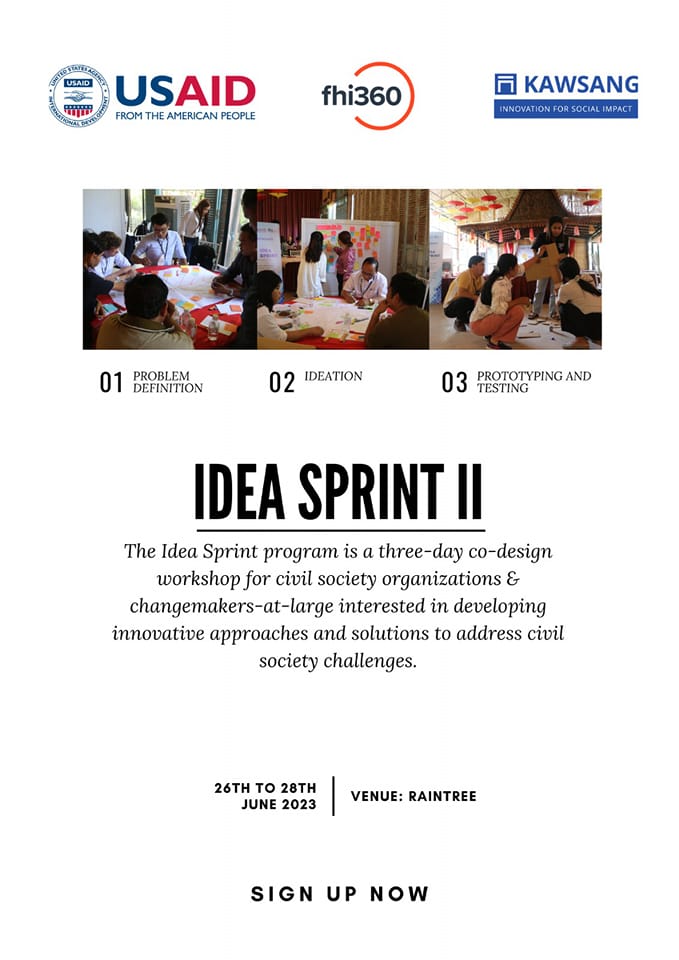
IDEA SPRINT II

The Idea Sprint program is a three-day co-design workshop for civil society organizations and changemakers-at-large interested in developing innovative approaches and solutions to address civil society challenges.

This is a full-day, 3-day participatory program. You will be assigned to a team of 5-7, based on your indicated interests and expertises, to work on the challenge you choose. You will work  as a team on this challenge throughout the program. We ask for your full participation for the entire program and will be a condition for acceptance into the program, which is conducted free-of-charge to participants.

Register: https://rb.gy/rmfhc

Other Events

Data Visualization in Journalism Training

Data visualization is the modern journalist\'s secret method in today\'s media landscape, where attention lengths are short and complexity abounds. It is the tool that enables stories to transcend the limitations of words, connecting with audiences through images that are meaningful to them. Journalists who master data visualization can easily navigate a flood of information, extracting patterns from chaos and presenting them in a way that is not only engaging but also immediately understandable. This training allows journalists to connect the power of data visualization, allowing them to skill narratives, engage, and leave a fast mark on the developing fabric of journalism. With our \"Data Visualization in Journalism\" training, you can embark on a transformative journalistic journey that explores the intersection of data and narrative. Data visualization, the art of transforming raw data into compelling visuals, is more than a skill; it\'s a narrative accelerator. In an age when information bombards our senses, journalists with data visualization skills gain the ability to change complex datasets, transforming them into impactful graphs, interactive charts, and dynamic maps that bring stories to life. This course provides an opportunity to seamlessly combine journalistic skills with data-driven precision, unleashing the potential of visual storytelling to captivate, inform, and inspire. Purpose The purpose of data visualization in journalism training is to equip journalists with the skills to integrate visual elements into their storytelling, enabling them to convey information, engage audiences, and unveil deeper narratives through impactful and accessible graphics. What will you learn? Understanding data: Understand how data represent reality. Recognize data type, data structure, and format as a means to understand how to prepare data for fulfilling the visualization. Principles of data visualization: Learn to understand the role of visualization in journalism. How to choose the right visual for a desirable purpose and get familiarity with commonly used visualization types. Principle of chart design: Learn how to design a good chart and make your presentation clear to your audience. Introduction to Datawrapper: Introduce what Datawrapper is and how to create a visualization with it. Practice data visualization with Datawrapper: Learn to create data visualization with the tool. Who should join? Journalist with strong familiarity with digital technology such as using smartphones, computers, and especially computer software such as Excel. Journalists who produce a lot of feature stories and that are required to use a lot of data. Journalists who aspire to learn new skills to enhance the quality of their reporting. Expected outcome The expected outcome of data visualization in journalism training is that participants will gain the ability to present complex data through compelling visual formats, enhancing the clarity and impact of their journalistic work while fostering a deeper connection with their readers or viewers. Eligibility Cambodian journalists (women, indigenous peoples, people with disabilities, and LGBTIQ+ are encouraged to join). Prerequisites Have a laptop and basic computer knowledge. Important date Open for registration: 15th August 2023 Close registration: 30th August 2023 Announce the selected candidate: 04th September 2023 Training date: 11th September 2023 For registration: https://rb.gy/a0rjt or scan QR Code below

Call for application: ASEAN-China Youth Exchange Camp

  • August 26-31, 2024
  • Full Day Event
  • Xiamen and Quanzhou, China
  • July 10, 2024

ASEAN-China Youth Exchange Camp is a collaborative programme between the ASEAN Foundation and the People’s Republic of China to ASEAN through the ASEAN-China Cooperation Fund. It aims to promote the significance and understanding of ASEAN-China relations. During the implementation, ASEAN Foundation will work with Xiamen University as the appointed local organiser. HOW TO APPLY Submit your application through https://bit.ly/ASEANChina_YECFrom_ASEAN (for ASEAN Students) and https://bit.ly/ASEANChina_YECForm_China (for China students) by 10 July 2024. Incomplete completion of the form will not be further processed for shortlisting. Don’t let go of this once-in-a-life time opportunity of becoming a cadre of future young leaders! For inquiries, please contact ACYC@aseanfoundation.org

9th International Conference: Shrinking Civic Space in Asia

  • August 21-23, 2024
  • Full-day
  • Bangkok, Thailand

Asia Centre’s 9th Annual International Conference will revolve around stories of resistance and pushback in defense of civic space in Asia. This topic is pressing and timely given the widespread contraction of civic spaces in the region, which poses a threat to the future of democratic societies. Registration is open to all presenters and participants from academic institutions, media outlets and journalist associations, businesses, national and regional civil society organizations, international NGOs, political parties, parliaments, government agencies, and intergovernmental organizations to facilitate knowledge sharing and networking. Researchers and practitioners wishing to present papers or share their experiences are invited to submit a title and abstract of 300–340 words in English, together with a biographical paragraph of 100 words, here. For those submitting papers, full papers should be 5,000 words (Please refer to the Style Sheet Guidelines). Following the international conference, the Asia Centre will publish the Conference Proceedings. Guidelines for the Conference Proceedings can be found here. Please contact us at contact@asiacentre.org Register here