


Theme: Youth powering media and information literacy in digital spaces
The UNESCO annual Global Media and Information Literacy Week is a major occasion for stakeholders to review and celebrate the progress achieved towards “Media and Information Literacy for All.”
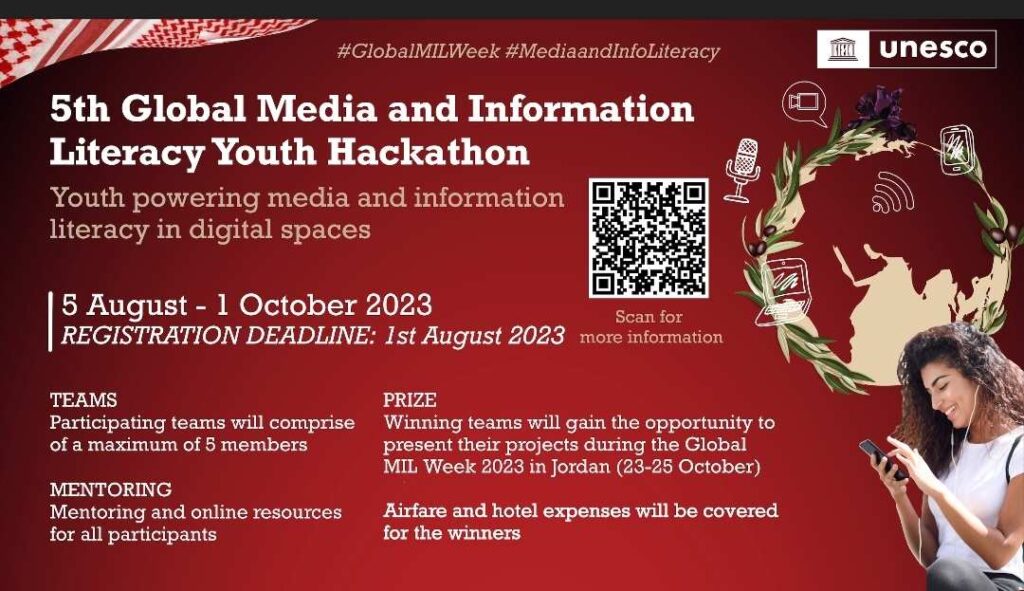
The Global Media and Information Literacy Youth Hackathon is an integral part of the Global Media and Information Literacy Week Youth Agenda Forum. It is an opportunity for young people and youth organizations worldwide to participate in creating innovative MIL learning in meaningful ways. Following the previous four successful editions, the fifth Global Media and Information Literacy Youth Hackathon will be held during Global MIL Week 2023.
UNESCO and partners call on youth worldwide to participate in this virtual hackathon to design innovative solutions to a defined set of social challenges, in connection with the year’s theme: “Youth powering media and information literacy in digital spaces.”
Youth from schools, universities, youth centers, youth organizations, and young leaders from around the globe are invited to participate. The winning teams and the outcome of the Hackathon will be presented during the Global MIL Week Youth Agenda Forum 2023.
Timeline
- 1 July 2023: Registration opens
- 1 August 2023: Registration ends
- Between 5-10 August 2023: Two-day mentoring on MIL and the hackathon
- 15 August 30 September 2023: Hacking processes (teams meet to hack issues and develop solutions)
- 1 October 2023: Deadline for submission of pitches (submission advised before the deadline)
- 2-10 October 2023: Judging process
- 25 October 2023: Announcement of winners and presentation of projects during the Global MIL Week 2023 Youth Agenda Forum.
Registration: https://indico.un.org/event/1005900/registrations/
For more information: https://www.unesco.org/en/media-information-literacy-week/fifth-youth-hackathon
Other Events
Young Professional Fellowship Canada 2025
Young Professional Fellowship Canada 2025 is an exciting new chapter of the Young Professional Fellowship program, dedicated to enhancing the leadership potential of youth under 40. This initiative focuses on experiential and innovative learning methods, empowering participants to become responsible and high-caliber leaders. Link to register: https://youngprofessionalfellowship.org/canada/
Tech Salon #15: Supercharge your team reports: AI-powered efficiency with Gemini and ChatGPT
Tech Salon #15 will discuss AI-powered efficiency with Gemini and ChatGPT. The monthly Tech Salon invites speakers from civil society organizations and experts to share experiences related to the use of institutional technology to learn from each other and enhance the use of ICT for social work. Pre-register: https://forms.gle/iG3WHEb33YMWk8ym7
Fundamentals of Brochure Design
At the 11th Tech Salon, we will discuss the basics of designing brochures for civil society organizations to advertise on social media using Canva tools. Registration: https://tinyurl.com/2sx32vu8